An interdisciplinary
AI research and
development platform
for marine
environments
sustainability

Start Exploring ↓
Coordinated Project BlueAI
Duration 48 months
Application Scope Mar Menor · Rías Baixas
Coordinating Institution University of Murcia (UMU)
Lead PIs Antonio F. Skármeta Gómez · Juan A. Botía Blaya
Subprojects BlueAI-UMU · BlueAI-UPV · BlueAI-USAL · BlueAI-UVigo
Logos oficiales BlueAI

01About BlueAI

BlueAI is a 48-month coordinated project focused on monitoring, modeling and interpreting marine ecosystems through Artificial Intelligence, combining IoT, advanced sensing, satellite data, Big Data analytics and Digital Twin technologies.

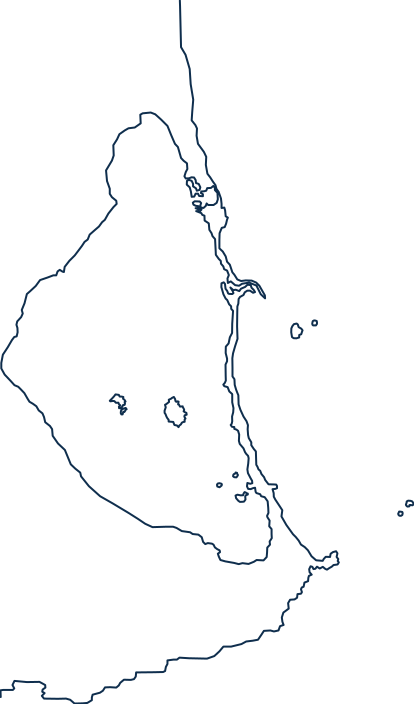
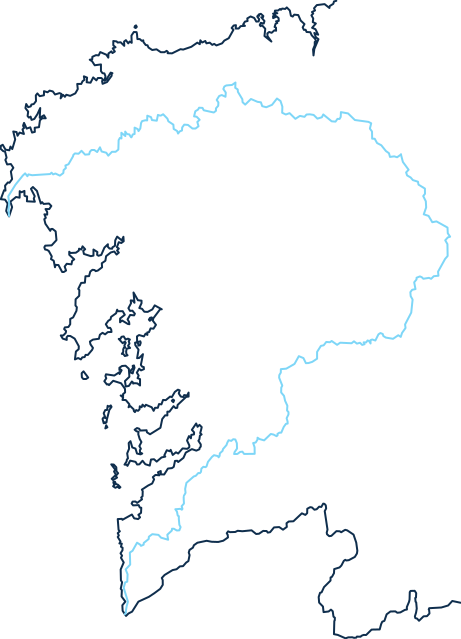
BlueAI focuses on two critical and environmentally relevant settings: Mar Menor and Rías Baixas.

Its core value is moving from reactive observation to predictive, action-oriented intelligence, with early warnings, what-if scenarios, and DSS support for technical, scientific, and management decisions.

To achieve this, BlueAI integrates multisensor acquisition, hybrid AI models and domain knowledge into a shared architecture designed to evolve throughout the full project lifecycle.

02Strategic Objectives

02.1Scientific Foundation

Build a stable interdisciplinary foundation across AI, oceanography and marine observation.

This objective includes a shared methodology across teams for data capture, validation and scientific exploitation.

Knowledge transfer between AI and marine science profiles is prioritized to accelerate actionable outcomes.

02.2European Infrastructure

Integrate BlueAI capabilities with EOSC, AIoD, Data Spaces and the DTO ecosystem.

BlueAI aligns with European infrastructures and standards for data and model interoperability.

This supports scale-up, reuse, and effective integration with key strategic initiatives.

02.3Prediction + DSS

Deploy a digital twin and DSS support with what-if scenarios for operational decisions.

The goal is to move from passive monitoring to event anticipation through robust predictive models.

The DSS integrates alerts, scenario simulation and direct support for technical and environmental management decisions.

02.4Environmental Impact

Improve conservation and management in Mar Menor and Rías Baixas with actionable models.

The end goal is measurable impact on water quality, ecosystem resilience, and response capacity.

Results are expected to become useful tools for research teams, public management and local stakeholders.

03How We Work

Sense -> Model -> Interpret -> Act

03.1Core Layer

First, we establish coordination, infrastructure, and shared rules so the project operates as one coherent system.

  • WP1 (coordination): project management, scientific quality, dissemination and uptake.
  • WP2 (infrastructure): common AI services and a shared technical foundation.

03.2Marine Intelligence Layer

Then we run the full cycle from observation to decision-making, turning data into environmental action.

  • WP3 (observe): advanced monitoring with sensing systems and heterogeneous sources.
  • WP4 (model): AI models for marine dynamics and predictive scenarios.
  • WP5 (act): interpretation, DSS and response/remediation strategies.

04Use Cases

Mar Menor

  • Challenge: nutrient pressure and ecosystem instability.
  • What BlueAI tracks: water quality, productivity and early risk signals.
  • Decision value: earlier intervention and adaptive management actions.

Rías Baixas

  • Challenge: hydrodynamic complexity and HAB-related risk.
  • What BlueAI tracks: circulation patterns, primary productivity, and risk evolution.
  • Decision value: preventive planning supported by predictive scenarios.

05Expected Impact

Scientific Impact

Expected outcome: stronger AI + marine science integration for ecosystem understanding.

How measured: validated models, reusable methods, and scientific outputs produced throughout the project.

Operational Impact

Expected outcome: shift from reactive monitoring to predictive and decision-ready operation.

How measured: DSS uptake in technical workflows and documented use in real decision scenarios.

Societal Impact

Expected outcome: better support for public management and stakeholder coordination in marine areas.

How measured: co-created use cases, stakeholder engagement actions, and practical transfer to institutions.

Ecosystem & Data Impact

Expected outcome: interoperable data-model architecture ready to scale beyond initial pilots.

How measured: integration readiness, reusable components and extension to new environments.

Impact is delivered progressively across the 48-month roadmap.

06Roadmap

M1-M12

Baseline Ready

Technical setup, requirements and first integrated baseline for the BlueAI stack.

M15-M29

Integration Validated

Infrastructure integration, validation cycle 1, and stakeholder co-creation activities.

M30-M38

Operational Pilot

Second monitoring-modeling-action cycle with model tuning in real decision contexts.

M39-M48

Transfer & Sustainability

DSS/DT consolidation, transfer packages and post-project sustainability pathway.

07Software & Data

Software and data resources will be published in a dedicated section as validated outputs become available.

View Software & Data ↗
Logos oficiales BlueAI